How Ketamine Works — The Science
It doesn't just change your mood. It rebuilds connections.
Traditional antidepressants nudge serotonin and wait weeks. Ketamine does something different — and more physical: it triggers a surge of glutamate that switches on the brain's own machinery for growing new connections between neurons. Here's the science, step by step.
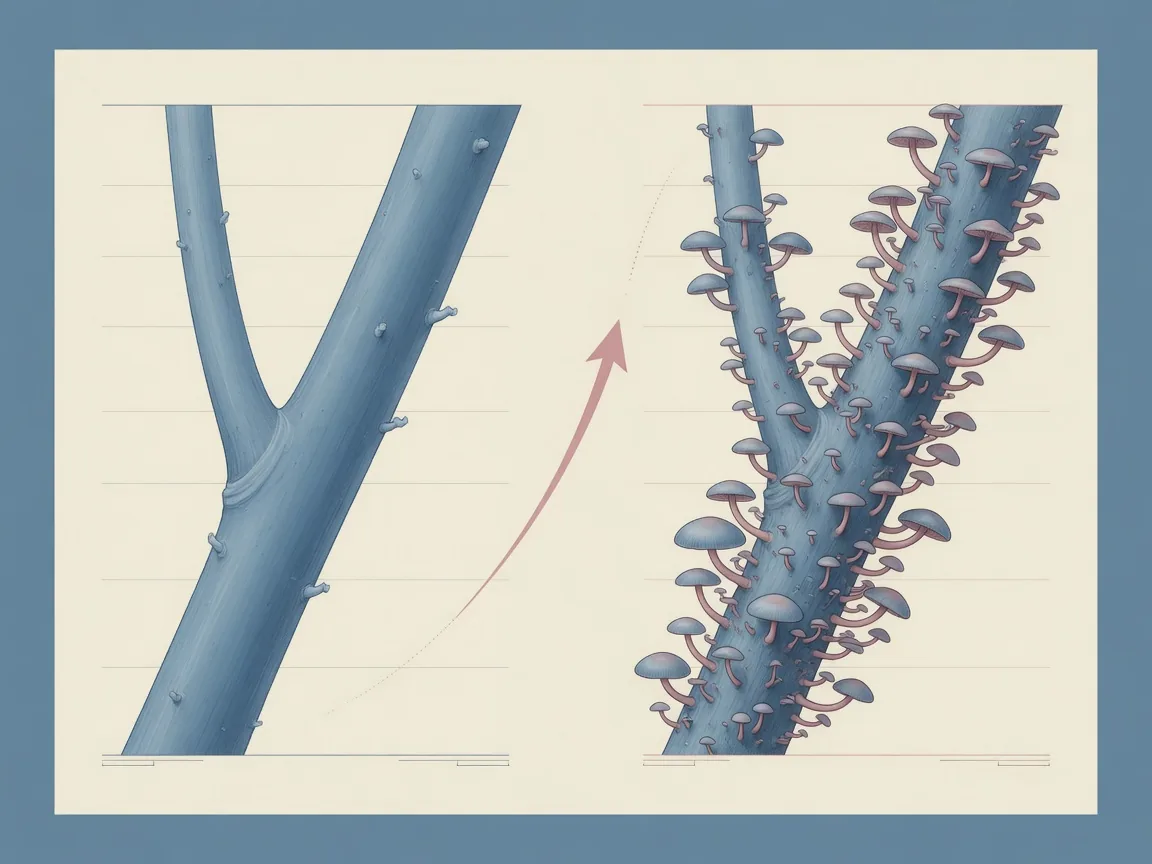
Micrograph: dendritic spine density before (top) and nerve growth after ketamine (bottom) — the synaptogenesis change documented in prefrontal-cortex research by Li et al. (2010).
A different kind of antidepressant
Not a chemical adjustment — a structural repair
For decades, the leading theory of depression was chemical: too little serotonin, so the fix was to raise it. That model explains why SSRIs help some people, but not why they take weeks to work — or why they fail for so many. A newer, better-supported model looks at structure rather than just chemistry.
Chronic stress and depression physically weaken and remove the connections between neurons in mood-regulating regions like the prefrontal cortex. Ketamine's power is that it reverses that loss directly — and quickly. The rest of this page walks through exactly how.
The cascade
From a blocked receptor to a new connection
Ketamine's antidepressant effect unfolds through a four-step molecular cascade. It begins the moment the medicine reaches the brain.
- 1
Ketamine blocks the NMDA receptor
Ketamine is an NMDA receptor antagonist. By briefly blocking NMDA receptors on inhibitory neurons, it lifts the brake those neurons hold on activity — setting the next step in motion.
- 2
A surge of glutamate is released
That disinhibition triggers a rapid burst of glutamate, the brain’s most abundant excitatory neurotransmitter, into the synapse — the "glutamate surge" at the heart of how ketamine works.
- 3
AMPA receptors activate growth signals
The glutamate surge activates AMPA receptors, switching on the BDNF–TrkB and mTOR signaling pathways — the cellular machinery the brain uses to build new synaptic connections.
- 4
New dendritic spines form
Those pathways drive synaptogenesis: the regrowth of dendritic spines, the tiny connection points between neurons that chronic stress and depression strip away.
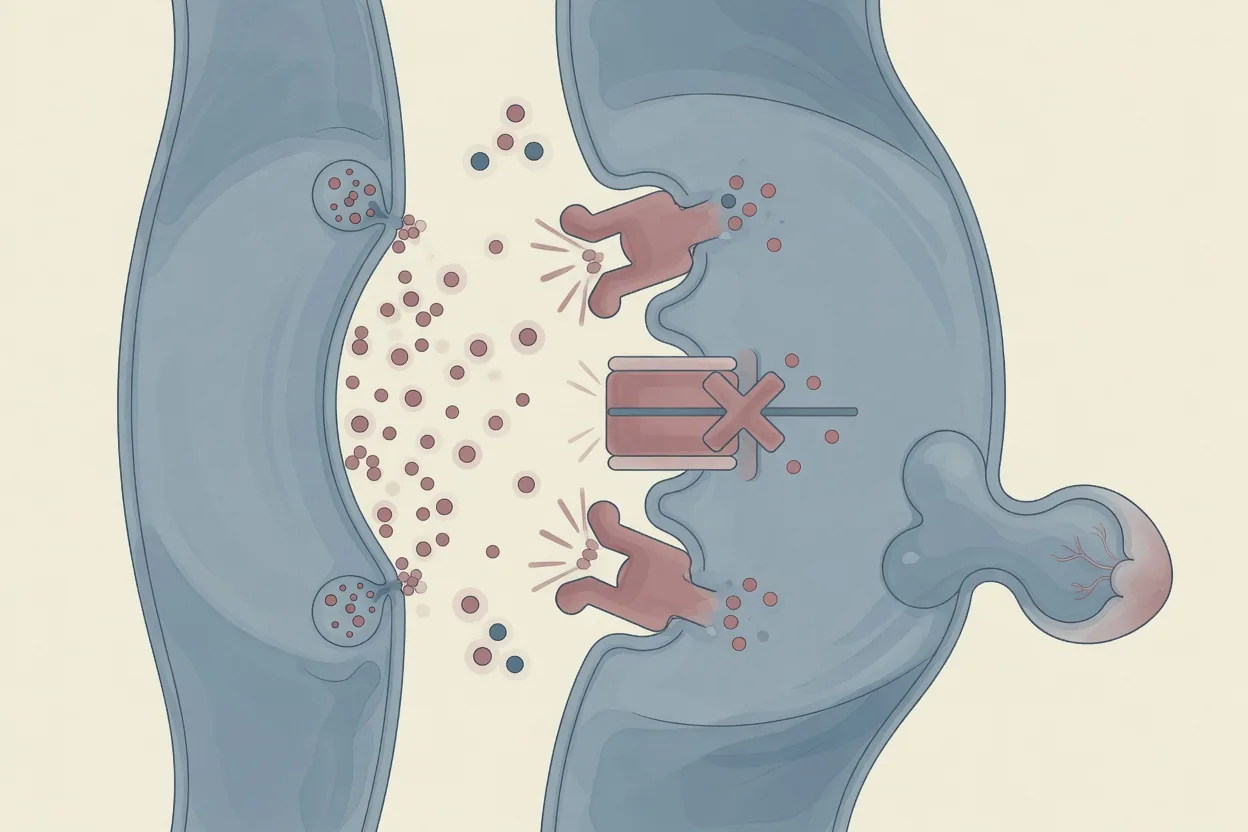
At the synapse: NMDA-receptor blockade (center) unleashes a surge of glutamate that activates AMPA receptors — the trigger for new spine growth.
Step 2, up close
The glutamate surge
Glutamate is the brain's most abundant excitatory neurotransmitter — the "go" signal of the nervous system. Normally its release is tightly restrained. When ketamine blocks NMDA receptors on the inhibitory neurons that hold it back, that restraint lifts and glutamate floods the synapse in a brief, controlled surge.
That surge is the spark. It activates AMPA receptors, which in turn switch on the BDNF–TrkB and mTOR pathways — the same growth-signaling machinery the brain uses to build and strengthen connections. In other words, ketamine doesn't supply the repair; it flips the switch that tells the brain to repair itself.
What the research shows
The dendritic spines actually grow back
This isn't only theory. In controlled research, ketamine measurably increased the number of dendritic spines in the prefrontal cortex — and the growth tracked with the recovery.
Within hours
Li et al. (2010) showed ketamine rapidly increased synaptic proteins and the number of new dendritic spines in the prefrontal cortex — on the same timescale as its antidepressant effect.
Li et al. (2010) →Spines restored
Moda-Sava et al. (2019) used live imaging to show ketamine regrew the specific dendritic spines lost to chronic stress, and that these new spines were necessary to sustain the behavioral recovery.
Moda-Sava et al. (2019) →A unified model
Duman et al. (2016) synthesized the field: rapid-acting antidepressants like ketamine reverse the synaptic loss caused by stress and depression, rather than only adjusting neurotransmitter levels.
Duman et al. (2016) →A note on the evidence: the direct imaging of dendritic spine regrowth comes from animal models, where the brain can be observed at the cellular level. Human studies support the broader synaptic model through neuroimaging and blood markers of plasticity. Together they form the leading scientific explanation for why ketamine works rapidly and, for many patients, durably.
Why this matters for you
A window worth using
The practical upshot of this biology is hopeful. Because ketamine works by rebuilding connections rather than slowly shifting brain chemistry, relief can arrive within hours to days — and it often holds after the medicine has cleared the body, because the new synapses remain.
It also opens a window of heightened neuroplasticity — a period when the brain is unusually able to form new patterns. That's one reason ketamine pairs so effectively with psychotherapy, and why prior medication failures don't predict a poor ketamine response: it's working on a different system entirely. To see how that plays out in treatment, read about ketamine for treatment-resistant depression or what to expect during an infusion.
Common questions
The science, answered
How does ketamine work in the brain?
Ketamine blocks NMDA receptors, which triggers a rapid surge of the neurotransmitter glutamate. That surge activates AMPA receptors and downstream growth pathways (BDNF–TrkB and mTOR) that drive synaptogenesis — the regrowth of dendritic spines, the connection points between neurons. This mechanism is fundamentally different from traditional antidepressants, which work slowly on serotonin and norepinephrine.
What is the "glutamate surge"?
Glutamate is the brain’s primary excitatory neurotransmitter. When ketamine blocks NMDA receptors on inhibitory interneurons, it releases the brake those neurons hold, producing a brief, controlled burst of glutamate. That burst is the trigger that switches on the brain’s synapse-building machinery — which is why ketamine’s effects can appear within hours rather than weeks.
Does ketamine really grow new connections in the brain?
Research in animal models shows that ketamine rapidly increases the number and function of dendritic spines in the prefrontal cortex — regions where chronic stress and depression cause spine loss. Li et al. (2010) in Science first demonstrated this rapid synaptogenesis, and Moda-Sava et al. (2019) later showed with live imaging that the newly formed spines were necessary to sustain recovery. Human research is ongoing, but this synaptic model is the leading explanation for ketamine’s rapid, durable effects.
What are dendritic spines and why do they matter for depression?
Dendritic spines are tiny protrusions on neurons that form the receiving side of a synapse — essentially the brain’s connection points. Chronic stress and depression are associated with the loss of these spines in mood-regulating regions like the prefrontal cortex. By promoting their regrowth, ketamine may help restore the circuit function that depression erodes.
Why does this make ketamine faster than antidepressants?
SSRIs and SNRIs gradually adjust serotonin and norepinephrine levels, and the downstream changes take four to six weeks. Ketamine skips ahead: by directly triggering the glutamate–AMPA–mTOR cascade, it begins driving synaptic growth within hours, which is why many patients notice a shift in mood within a day or two of their first infusion.
Is the science the same for IV ketamine and Spravato?
Both act on the glutamate system through NMDA-receptor antagonism, so the core mechanism is shared. They differ in delivery, dosing precision, and formulation — IV ketamine is the full racemic molecule titrated in real time, while Spravato is the esketamine nasal spray. See our infusions vs. Spravato comparison for how that translates to results.
The ketamine resource center
Keep exploring ketamine therapy
Ketamine Infusion Therapy →
The main guide to IV ketamine at The Practice — conditions, research, and booking.
Near Ponte Vedra →
Ketamine infusions for Ponte Vedra patients — ~25 min to our San Marco clinic.
Near Jacksonville Beach →
Ketamine infusions for Jacksonville Beach patients — ~25 min to our San Marco clinic.
Near Southside →
Ketamine infusions for Southside patients — ~15 min to our San Marco clinic.
Near Westside →
Ketamine infusions for Westside patients — ~20 min to our San Marco clinic.
Near Riverside / Avondale →
Ketamine infusions for Riverside / Avondale patients — ~10 min to our San Marco clinic.
Near Orange Park →
Ketamine infusions for Orange Park patients — ~25 min to our San Marco clinic.
Near Mandarin →
Ketamine infusions for Mandarin patients — ~20 min to our San Marco clinic.
Near St. Augustine →
Ketamine infusions for St. Augustine patients — ~40 min to our San Marco clinic.
Near Nocatee →
Ketamine infusions for Nocatee patients — ~30 min to our San Marco clinic.
Treatment-Resistant Depression →
When two or more antidepressants haven’t worked — what ketamine offers TRD.
Ketamine for Anxiety →
Rapid relief for persistent anxiety, panic, and nervous-system activation.
Ketamine for PTSD →
Trauma-informed infusion care for hypervigilance and flashbacks.
Ketamine for Chronic Pain →
CRPS, neuropathy, migraines, and centralized pain protocols.
Cost & Insurance →
The dedicated guide to infusion costs, insurance, and payment questions.
Infusions vs. Spravato →
How IV ketamine and the FDA-approved nasal spray compare on results and cost.
What to Expect →
Your first infusion, hour by hour — preparation, the experience, and recovery.
What Is Ketamine Therapy? →
The complete beginner’s guide: history, mechanism, safety, and evidence.
Veterans & the VA →
How VA coverage works for Spravato and IV ketamine, and the Community Care path.
Ketamine FAQ →
Every common question about ketamine in Jacksonville, answered in one place.
Side Effects & Safety →
What to expect: nausea, dizziness, dissociation, blood pressure — and who shouldn’t use ketamine.
The Experience →
Does ketamine get you high? Honest answers about what an infusion actually feels like.
Preparation Guide →
What to eat, what to avoid, what to bring, and how to set yourself up for the best experience.
Aftercare Guide →
First 24 hours, the week after, and how to maximize the neuroplasticity window.
Treatment Protocol →
The standard 6-infusion induction series, why a series matters, and maintenance scheduling.
Ketamine for OCD →
For obsessive-compulsive disorder: how ketamine’s glutamate mechanism may interrupt the OCD loop.
Ketamine for Bipolar Depression →
When antidepressants can’t be used — how ketamine differs for bipolar patients on mood stabilizers.
Ketamine vs. ECT →
How IV ketamine compares to electroconvulsive therapy — efficacy, side effects, and logistics.
Success Rates & Evidence →
What the research actually shows: response rates, remission rates, and what the numbers mean.
Patient Stories →
Real patient experiences with ketamine therapy at The Practice — depression, PTSD, and chronic pain.
Put the science to work for you
Understanding the mechanism is one thing — finding out whether it's right for you is the next step. Consultations are available in person or via Zoom. The provider who will direct your care will review your history and goals and give you an honest recommendation.
or call (904) 877-1100